
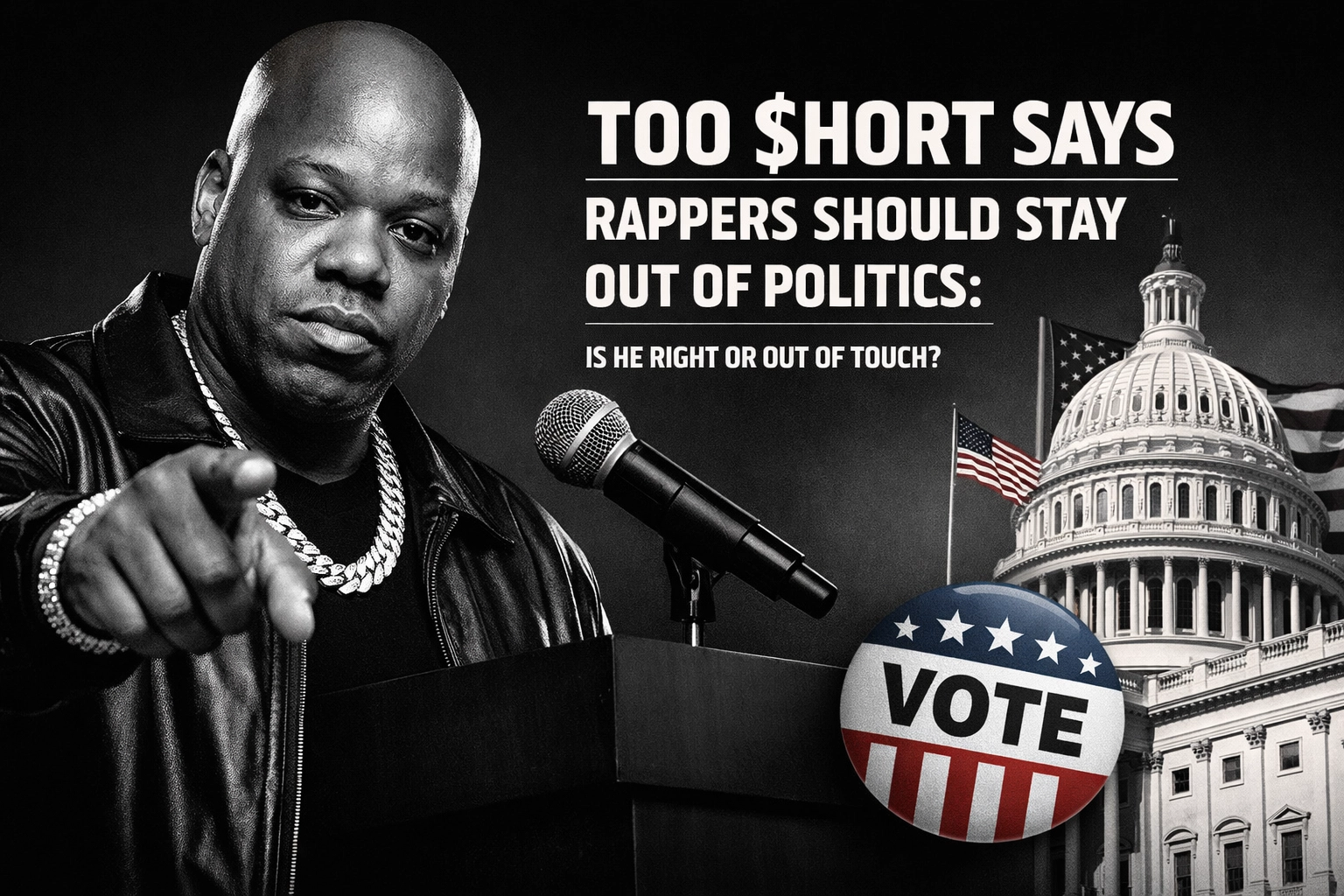
Is Too $hort right that rappers should stay out of politics? Yes and no—yes about the clout-chasing part, no about the reality part.
I’m Kalum, and when Too $hort hopped on TMZ saying rappers should keep politics out the music and handle it at the ballot box… I laughed, then I sighed. Because I get what he means, but I also know how this goes in real life for us.
Now let’s get the facts straight, because the internet loves turning one sentence into a whole riot.
What Too $hort actually said (the facts, no cap)
Too $hort’s main point in the TMZ clip was basically:
- Vote. Be involved.
- But don’t turn your music and public identity into a loud political billboard where every bar feels like a campaign commercial.
- He framed it like: keep the heavy political stuff in the voting booth, not in the branding.
Then—because people immediately acted like he said “nobody should care”—he clarified with the energy of:
- “No Americans should stay out of politics. Especially in 2026.”
So nah, he wasn’t saying “be clueless.” He was saying don’t make politics your whole personality.
And honestly? That’s a different argument than “shut up and rap.”
Why Too $hort would even say this (and why it makes sense to him)
Here’s the “why” behind his take: money, reach, and backlash.
Too $hort comes from an era where you could drop a record, do your shows, and folks didn’t demand you also be a full-time senator on Instagram Live. In 2026, if a rapper says “I like pancakes,” somebody screenshots it like, “So you hate waffles and the working class?” Now imagine making your whole brand “political.”
From a business lens:
- Politics is a brand splitter.
- Once you go all-in publicly, a chunk of your audience turns into critics, not fans.
- Labels, sponsors, and venues start acting scary because controversy messes with bookings.
So when Too $hort says “keep it to the ballot box,” he’s really saying:
“Stop letting politics hijack your music and your bag.”
But hip hop was never “non-political” (let’s be real)
Now here’s where folks start arguing in the comments like it’s a pay-per-view.
Hip hop—especially on the West Coast—has always been political, even when it wasn’t wearing a suit and tie:
- N.W.A. didn’t make “F*** tha Police” for bipartisan unity. That was about police harassment and the system in Compton.
- 2Pac rapped about poverty, surveillance, prison, and racism—because that was life.
- Kendrick’s “Alright” became a protest anthem because it spoke to the mood: we tired, but we still here.
That wasn’t some party commercial. That was Black reality. And reality is political whether we want it to be or not.
The real issue: rappers using politics for clout vs. using it for the community
This is where Too $hort’s warning actually hits.
There’s a difference between:
- Rapping about what’s happening to Black people (police, housing, schools, jobs, courts), and
- Cosplaying as a political spokesperson because it’s trending.
Why clout-politics can harm the Black community
Because when a rapper with a huge platform treats politics like a rollout, a few things happen:
-
Misinformation spreads fast.
If you got 10 million followers and you post something wrong, congrats—you just taught a whole generation the incorrect version of civic life. -
It turns Black issues into “teams,” not solutions.
Instead of “how do we stop the bleeding,” it becomes “are you on my side?” That’s how we end up arguing about personalities while policies cook us quietly. -
It can get our people played.
Politicians love a celebrity endorsement because it’s cheaper than actually fixing anything. A photo-op costs less than a program.
So Too $hort’s “don’t make it your brand” is partly him saying:
“Don’t let them use you—and don’t use us—for content.”
Why this matters right now for Black folks (2026 problems, real consequences)
My bills don’t care what I feel about politics. The Black community is dealing with stuff that’s not theoretical:
- Voting access fights (rules, IDs, district maps—aka the “we’ll let you vote, but make it difficult” Olympics)
- Economic inequality (wages vs. rent—rent been rapping on beat, wages off tempo)
- Police reform debates (and the same “thoughts and prayers” cycle)
- Education and curriculum battles (what history gets taught and whose story gets erased)
So when rappers speak—especially rappers with influence—there’s impact. That impact can be positive… or messy. Because for us, this isn’t hobby-politics. Black life is inherently political: where we can live, how we get policed, what schools look like, what gets funded, who gets locked up, who gets believed.
So is Too $hort right?
He’s right about one big thing: political branding can turn art into propaganda and split audiences into tribes.
And when it’s fake, people feel it. Hip hop punishes fake.
But he’s also missing (or underweighting) another truth:
Black life is political whether rappers mention it or not.
Silence doesn’t protect us. Sometimes silence just protects somebody’s comfort.
The better middle is:
- Be political about Black conditions (systems, policies, realities),
- Be careful about turning into a walking campaign flyer, and
- If you’re gonna speak, do the homework—because our community pays for mistakes.
My take (and my joke before I go)
If a rapper wants to talk politics, cool. Just don’t do it like you reading a flyer you got handed outside Target like, “Excuse me sir, would you like a democracy today?”
Talk about:
- what the policy is,
- why it exists (who benefits),
- who it hurts (usually us),
- and what people can actually do (vote, organize, show up locally).
And this is where the conversation comes full circle: when Too $hort says “keep it to the ballot box,” I hear the warning behind it—don’t let politics become a gimmick that messes up the music and gets the community used as a prop. But I also can’t pretend we can “keep politics out” of anything when Black life is already in politics the moment we step outside.
So yeah—Too $hort is right about protecting the culture from clout politics. And he’s wrong if anybody takes it as “be quiet.” The real move is: be loud with facts, be real with the message, and remember who’s affected when the talk turns into a trend.
At PolitiKan Broadcasting, I’m always going to care about where hip hop, politics, and Black life collide—because that collision is real, and it’s not going away. Tap in with more coverage at politikanbroadcasting.org where we break it down plain and keep it honest.

Leave a Reply